This paper introduces several temperature measuring instruments and their applications, including RTDs, thermocouples, bimetallic thermometers, pressure-type thermometers, and glass thermometers.
Classification and Application of Temperature Measuring Instruments
1. What are the categories of temperature measuring instruments based on the temperature measurement method? What are the characteristics of each?
Based on the temperature measurement method, temperature measuring instruments can be divided into two categories: contact-type temperature instruments and non-contact-type temperature instruments.
Contact-type temperature instruments achieve good contact between the temperature-sensing element and the measured object, making their temperatures equal. These instruments have a relatively simple and reliable structure and high measurement accuracy. However, since it takes a certain time for the temperature-sensing element and the measured object to reach thermal equilibrium, there is a delay phenomenon. In addition, limited by high-temperature materials, they cannot measure extremely high temperatures.
Non-contact-type temperature instruments do not have the temperature-sensing element in contact with the measured object; instead, they measure through the thermal radiation or electromagnetic properties of the measured object. These instruments have no limit on the upper measurement range, do not disrupt the temperature field of the measured object, and have a relatively fast response. However, they are affected by external factors such as the emissivity of the emitting object, measurement distance, flue gas, moisture, and dust, resulting in relatively large measurement errors.
2. What are the types of on-site temperature measuring instruments? Which occasions are they suitable for?
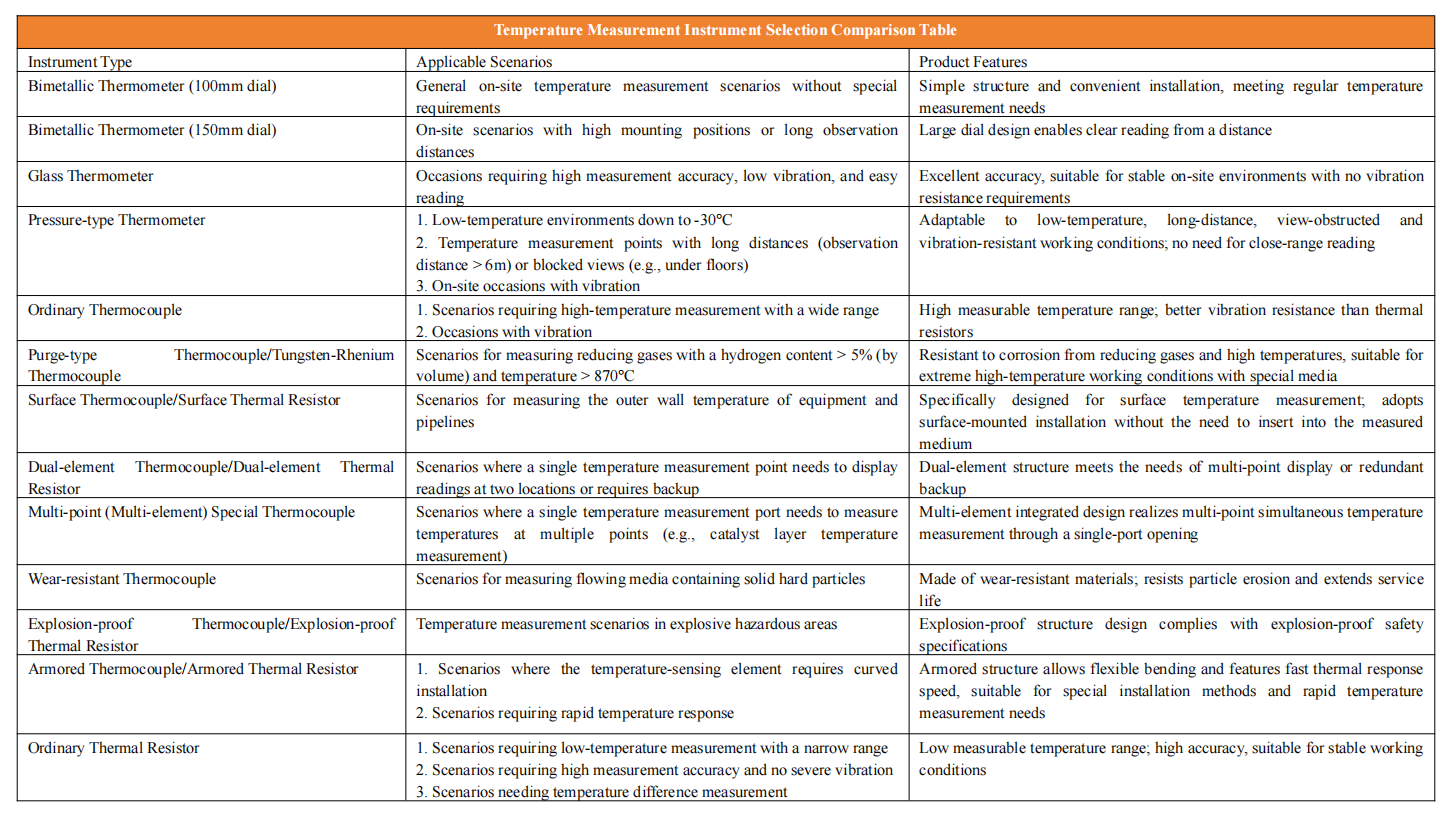
On-site temperature measuring instruments include bimetallic thermometers, glass thermometers, pressure-type thermometers, etc.
In general, a bimetallic thermometer can be selected. It has a dial diameter of 100mm; if the installation position is high or the observation distance is far, one with a dial diameter of 150mm should be used.
A glass thermometer is suitable for occasions that require high measurement accuracy, little vibration, and convenient reading.
A pressure-type thermometer can be selected for the following occasions:
① Measuring low temperatures down to -30°C;
② When the temperature measurement point is far away, the observation distance exceeds 6m, or the temperature measurement pipeline is under the floor and obstructs the view;
③ Occasions with vibration.
3. How to select thermocouples and thermal resistors?
① Thermocouples and thermal resistors are generally selected according to the temperature measurement range. Thermocouples have a higher measurement temperature and a larger range, while thermal resistors have a lower measurement temperature and a smaller range. For occasions with vibration, thermocouples are preferred. For occasions that require high measurement accuracy, no severe vibration, or temperature difference measurement, thermal resistors are preferred.
② When measuring reducing gas with a hydrogen content greater than 5% (by volume) and a temperature higher than 870°C, a purge-type thermocouple or a tungsten-rhenium thermocouple should be selected.
③ When measuring the outer wall temperature of equipment and pipelines, a surface thermocouple or a surface thermal resistor is selected.
④ When a temperature measurement point needs to display readings in two places or requires a backup, a dual-element temperature-sensing element is selected.
⑤ When a temperature measurement port needs to measure temperatures at multiple points (such as catalyst layer measurement), a multi-point (multi-element) special thermocouple is selected.
⑥ When measuring a flowing medium containing solid hard particles, a wear-resistant thermocouple is selected.
⑦ In explosive hazardous areas, explosion-proof thermocouples and thermal resistors are selected.
⑧ When the temperature-sensing element requires curved installation or rapid response, armored thermocouples and thermal resistors can be selected.
4.To ensure measurement accuracy, what requirements should be followed for the installation of temperature-sensing elements?
To ensure measurement accuracy, in industrial settings, the installation of temperature-sensing elements generally follows the following requirements:
① When installing a temperature-sensing element on a pipeline, it should ensure full contact between the temperature-sensing element and the fluid. Therefore, the temperature-sensing element should face the flow direction of the measured medium, forming an angle of at least 90° with the flow direction; it must not be in the same direction as the measured medium.
② When installing a mercury thermometer or a thermocouple on a pipeline with a nominal diameter less than 50mm, or installing a resistance thermometer or a bimetallic thermometer on a pipeline with a nominal diameter less than 80mm, the thermometer should be installed on an additional expanded pipe.
③ The working end of the temperature-sensing element should be located at the position with the maximum flow velocity in the pipeline. For expansion thermometers, the center of the temperature measurement point should be placed on the center line of the pipeline. The ends of the protective sleeves of thermocouples, platinum thermal resistors, and copper thermal resistors should extend beyond the center line of the flow beam by 5-10mm, 50-70mm, and 25-30mm respectively. The center of the bulb of a pressure-type thermometer should coincide with the center line of the pipeline.
④ There should be a sufficient insertion depth to reduce measurement errors.
⑤ The junction box cover of thermocouples and thermal resistors should face downward to prevent rainwater or other liquids from seeping in and affecting the measurement. There should be no strong magnetic fields near thermocouples.
⑥ To reduce the temperature measurement lag, a filler with good thermal conductivity can be added between the protective outer sleeve and the protective sleeve, such as transformer oil (for temperatures <150°C) or copper chips/quartz sand (for temperatures >150°C).
5.What are the fixing methods for installing temperature-sensing elements on pipelines and equipment? Which occasions are they suitable for?
There are generally two fixing methods: ① Threaded connector fixing; ② Flange fixing.
The threaded connector fixing method is generally suitable for installing temperature-sensing elements on pipelines with non-corrosive media. It has the advantages of small size and compact installation.
The flange fixing method is suitable for installing temperature-sensing elements on equipment. It should also be used in occasions involving high temperatures, highly corrosive media, coking sludge media, highly toxic media, powdery media, and multi-point temperature measurement of catalyst layers for easy maintenance.